
Does My Panel Support an EV Charger? A Homeowner's Guide

Table of Contents
How to Determine Whether Your Electrical Panel Can Support an EV Charger
What You'll Need to Check
The Three-Step Assessment Process
Understanding Your Service Capacity and Panel Amperage
100-Amp Versus 200-Amp Service
Breaker Space Versus Available Electrical Capacity
EV Charger Load Calculation and Your Home's Electrical Demand
How Load Calculations Work: A Practical Example
Level 2 Charger Requirements and Charging Current
Installing an EV Charger on a 100-Amp Panel
EV Charger Installation With a Full Electrical Panel: Your Options
Upgrading Your Main Panel
Installing a Subpanel for Your EV Charger
Load Management and Charger Settings
Common Mistakes to Avoid When Checking Panel Compatibility
When to Call a Licensed Electrician
Frequently Asked Questions
Last Updated: October 5, 2026
How to Determine Whether Your Electrical Panel Can Support an EV Charger
Whether your electrical panel can support an EV charger comes down to three things: your home's total service capacity, your charger's power draw, and whether you have room for a new dedicated circuit, all factors that determine if your panel support EV charger installation. At Thevenin Electric, we answer this question weekly, and it's rarely a simple "yes" or "no."
Most people assume a full breaker panel means they can't add anything. Not true, the real constraint is available electrical capacity, not breaker space.
What You'll Need to Check
Before calling a licensed electrician, gather:
Main service amperage (the main breaker will say 100, 150, or 200 amps)
Major appliances and their power draw (electric water heater, HVAC, electric stove, dryer)
The EV charger type you want (Level 2 is standard)
Any available breaker spaces in your panel
You'll also need your address and utility company, since some utilities have specific EV charger requirements.
The Three-Step Assessment Process
Step 1: Find your main service amperage. Look at the largest breaker at the top of your panel. It will be labeled 100, 150, or 200 amps. Write this down.
Step 3: Check available capacity. Subtract your current load from your total service amperage. A Level 2 EV charger typically requires 30-50 amps of dedicated capacity.
Here's the catch: the National Electrical Code requires your total connected load not exceed 80% of service capacity for continuous loads, and an EV charger running for hours counts as one.
Understanding Your Service Capacity and Panel Amperage
Your electrical service capacity is the maximum power your utility will deliver at one time, measured in amps. Most homes built before 2000 have 100-amp service; newer homes typically have 200-amp service.
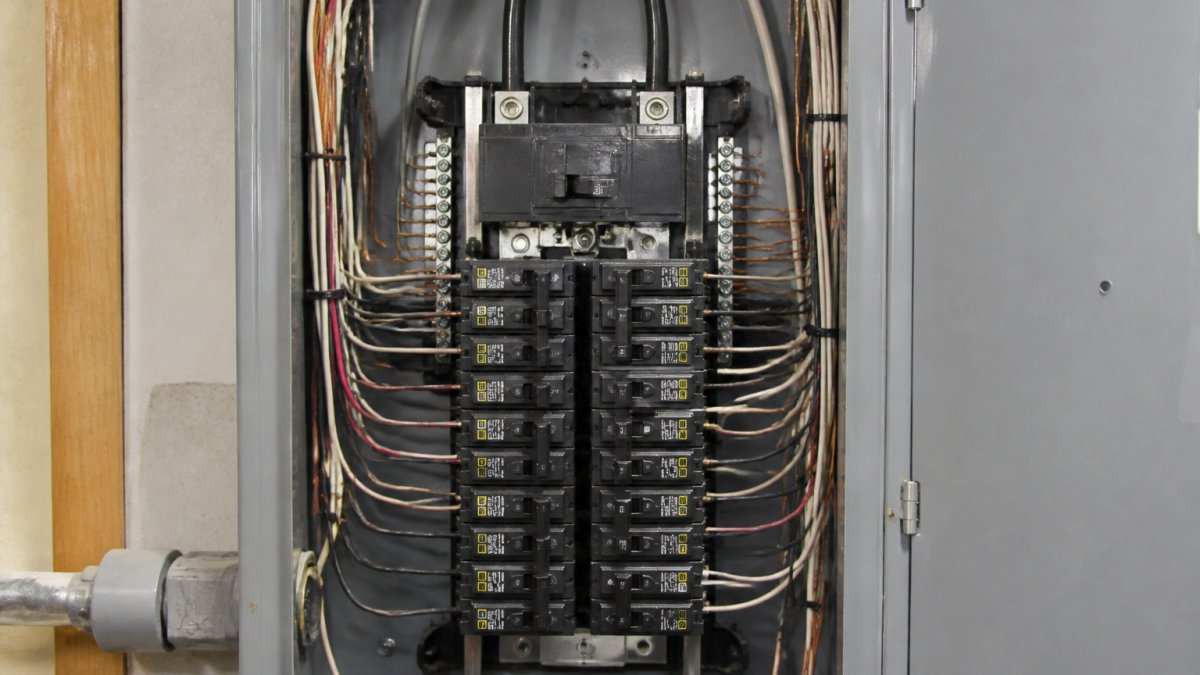
100-Amp Versus 200-Amp Service
A 100-amp panel delivers 100 amps at any moment, but only about 80 amps continuously, leaving 20 amps of headroom, not enough since most Level 2 chargers need 30-50 amps.
A 200-amp panel gives 160 amps of continuous capacity. After your water heater, HVAC, and other major loads, you'll likely have 40-60 amps available, usually enough for a Level 2 charger without an upgrade.
Practically: 100-amp service almost always needs a panel upgrade for an EV charger; 200-amp service might not.
Breaker Space Versus Available Electrical Capacity
This is where most homeowners get confused. A full panel doesn't mean you're out of capacity.
Your panel has physical slots for breakers. If all are filled, you have no breaker space, but breaker space and electrical capacity are different things.
If your panel is full, install a subpanel for more breaker space or combine existing circuits to free a slot. A subpanel is almost always cleaner.
Available electrical capacity is what matters for safety. If your panel support EV charger installation, you need both breaker space and available amps.
EV Charger Load Calculation and Your Home's Electrical Demand
An EV charger load calculation determines how much power your charger draws and whether your home's electrical system can handle it alongside everything else.
Electric Vehicle Insiders
The National Electrical Code requires calculating your home's total electrical load, everything that could run at once, and confirming your service amperage is sufficient. This is complex because not everything runs simultaneously: HVAC, water heaters, and refrigerators run intermittently, while an EV charger draws power continuously for 4-10 hours at a time.
How Load Calculations Work: A Practical Example
Let's say you have a 200-amp service panel. Your major loads are:
Main breaker: 200 amps
Electric water heater: 40 amps
Central air conditioning: 20 amps
Electric range: 50 amps
Dryer: 30 amps
Lighting and outlets (rest of home): 20 amps
Your total connected load is 160 amps, but these appliances won't all run at once. The code uses demand factors:
Water heater: 40 amps (full load, runs continuously)
AC: 20 amps (full load, runs during cooling)
Range: 80% of nameplate (40 amps, because you rarely use all burners)
Dryer: 80% of nameplate (24 amps, because it cycles)
General lighting and outlets: 20 amps
Your calculated demand load is about 144 amps, leaving roughly 16 amps of available capacity under the 80% rule (160 × 0.80 = 128, minus 112 = 16). A Level 2 charger needs 30-50 amps, so you'd need a panel upgrade.
This is simplified. A licensed electrician will use more detailed demand factors based on your specific home and appliances.
Level 2 Charger Requirements and Charging Current
A Level 2 EV charger runs on a 240-volt circuit, the same as your range or water heater, and draws 16 to 50 amps depending on the model and configuration.
Most residential Level 2 chargers are rated for 30 or 40 amps. Some are adjustable, meaning you can set them to draw less power if your panel doesn't have enough available capacity.
Insider tip: if your electrician says your panel can't support a 40-amp charger, ask about a 30-amp model or an adjustable charger set to 24 amps.
The National Electrical Code requires a dedicated circuit for an EV charger, no sharing.
Installing an EV Charger on a 100-Amp Panel
Installing an EV charger on a 100-amp panel is possible, but it usually requires compromises.
A 100-amp panel has about 80 amps of continuous capacity.
Your options are:
Option 1: Panel upgrade. Replace your 100-amp service with 200-amp service. It's the most straightforward but most expensive solution, requiring utility coordination and a permit.
Option 2: Subpanel. A subpanel fed from your main panel adds breaker space and lets you redistribute loads.
Option 3: Adjustable charger. Install a Level 2 charger set to a lower amperage, 16 or 20 amps instead of 40.
Most electricians recommend a panel upgrade or subpanel. Managed and adjustable charging work, but add complexity and reduce charging speed.
EV Charger Installation With a Full Electrical Panel: Your Options
A full electrical panel means every breaker slot is occupied, leaving no space for a new EV charger breaker without removing an existing one.
The key distinction: a full panel doesn't necessarily mean you're out of capacity. You might have available amps but no breaker space, or be out of both.
Upgrading Your Main Panel
A main panel upgrade replaces your 100-amp or 150-amp service with 200-amp service, giving you more breaker slots and total capacity.
A panel upgrade requires:
A permit from your local building department
An inspection by a licensed electrician
Coordination with your utility company (they may need to upgrade the service line to your home)
A potential increase in your electrical bill (some utilities charge higher rates for higher service amperage)
The process typically takes 1-2 weeks from permit application to final inspection, with power shut off for a few hours during the upgrade.
A panel upgrade is the most comprehensive solution, solving both the breaker space and capacity problems. If you plan to add other major loads, a hot tub, electric heating, or a second EV charger, it makes sense.
Installing a Subpanel for Your EV Charger
A subpanel is a secondary panel fed by a breaker in your main panel, with its own breaker slots for new circuits.
A subpanel installation requires:
A dedicated circuit from your main panel (usually 60-100 amps, depending on the subpanel size)
Conduit and wire running from the main panel to the subpanel location
A permit and inspection
A licensed electrician to perform the work
A subpanel costs less than a full panel upgrade but more than a simple circuit addition, the middle-ground solution: more breaker space without replacing your entire service.
Its advantage is flexibility. You can locate it closer to your EV charger, reducing wire needed, and use it for other loads in the future.
Load Management and Charger Settings
Load management reduces your home's peak electrical demand by controlling when and how fast your EV charger runs.
Some Level 2 chargers have built-in load management.
Example: your home's peak demand is usually 120 amps. Your service is 200 amps.
This approach works but adds cost (smart chargers are more expensive than standard ones) and requires integration with your home's electrical system.
Charger settings are another option. Most Level 2 chargers let you adjust the charging current via a dial, app, or button.
The trade-off: lower amperage means slower charging.
Common Mistakes to Avoid When Checking Panel Compatibility
Mistake 1: Assuming a full panel means no capacity. A full panel is an inconvenience, not a deal-breaker.
Mistake 2: Confusing breaker space with electrical capacity. These are different.
Mistake 3: Ignoring demand factors. Your water heater, AC, and range don't all run at the same time. Account for this when calculating capacity.
Mistake 5: Oversizing your charger. Just because you can install a 50-amp charger doesn't mean you should.
Mistake 6: Not considering future loads. If you're planning to add a hot tub, heat pump, or second EV in the next few years, account for that now.
When to Call a Licensed Electrician
You should call a licensed electrician if:
You're unsure about your main service amperage
Your panel is full and you want to add an EV charger
Your home was built before 1980 (older panels may have safety issues)
You've had recent electrical problems (flickering lights, tripped breakers, burning smells)
You want an accurate load calculation
You need a permit for the installation
A licensed electrician will perform a site assessment, measure your available capacity, and recommend the best installation option. At Thevenin Electric, we provide a detailed quote before any work begins.
An assessment typically takes 30-60 minutes. The electrician will open your panel, check the main breaker amperage, review your appliances, and ask about your future electrical plans. They'll then calculate whether you have enough capacity for an EV charger and recommend the most cost-effective installation method.
Frequently Asked Questions
Can I install a Level 2 EV charger on a 100-amp panel?
It depends on your available capacity. A Level 2 charger typically requires 30-50 amps of continuous load. With a 100-amp service, you can support an EV charger if your existing household loads (heating, cooling, water heater, appliances) don't exceed 50 amps combined. A licensed electrician can perform a load calculation to determine if your panel has enough available capacity. If it doesn't, a subpanel or service upgrade may be necessary.
What's the difference between breaker space and available electrical capacity?
Breaker space refers to empty slots in your panel where new circuit breakers can be installed. Available capacity refers to the actual electrical power your panel can supply after accounting for existing household loads. A panel may have empty breaker slots but insufficient available capacity, or vice versa. Both must be adequate for an EV charger installation. Your electrician assesses both during a site visit.
How does an EV charger load calculation work?
A load calculation determines the total electrical demand your home requires at any given time. Your electrician adds up the amperage of all major appliances and systems (furnace, air conditioner, water heater, kitchen loads) plus the EV charger's demand. If the total exceeds your panel's available capacity, you'll need to upgrade your service or install a subpanel. For example, a home with 40 amps of existing load plus a 40-amp charger needs at least 80 amps of available service capacity.
Do I need a panel upgrade or a subpanel for an EV charger?
A subpanel is often the more cost-effective option if your main panel is full or lacks capacity. It draws power from your main panel through a larger breaker and provides dedicated circuits for the charger. A full panel upgrade increases your main service from 100 to 200 amps, providing more overall capacity for future needs. Your electrician will recommend the best option based on your home's electrical layout, local code requirements, and long-term plans.
If your panel support EV charger installation is uncertain, the next step is a professional assessment. Thevenin Electric specializes in EV charger installations and panel upgrades for homeowners throughout the region. We work directly with you to understand your home's electrical system, explain your options clearly, and deliver clean, code-compliant installations with fast response times. Request a quote today and let us help you get your EV charger installed safely.
Request a Quote
Comments